Howdy! For those of you who haven't yet moved your email subscription request to my new blog....
I just posted a list of great children's books for gift giving:
http://sites.paideiaschool.org/wordpress/natalie/the-pithy-python-the-library-blog/
Join me over there! There's an box for email subscriptions. You may need to check your spam filter for the first confirmation.
And let me know if you have trouble receiving email updates:
bernstein.natalie@paideiaschool.org
Tuesday, November 13, 2012

Tuesday, August 21, 2012
I'VE MOVED!
Over the summer I merged my blog and web page at a new site!
http://sites.paideiaschool.org/wordpress/natalie/the-pithy-python-the-library-blog/
Please follow me there -- update your RSS or your email subscription and I'll keep updating you on all kinds of library activities, stories and information about reading.
Let me know if you have trouble switching over:
bernstein.natalie@paideiaschool.org
http://sites.paideiaschool.org/wordpress/natalie/the-pithy-python-the-library-blog/
Please follow me there -- update your RSS or your email subscription and I'll keep updating you on all kinds of library activities, stories and information about reading.
Let me know if you have trouble switching over:
bernstein.natalie@paideiaschool.org
Friday, June 1, 2012
(If you can't see the pictures, click to go directly to The Pithy Python.)
Reflections on the last week, the last day of school:
We check out books to parents but not to kids for the summer. Retrieving those books checked out to kids is our least favorite activity. Lauren and I started sending reminders to children with overdue books about ten days ago. They get a verbal reminder, a printed reminder, a teacher reminder and then finally an email to a parent. The email offers to move the book to the parent account if the parent will just acknowledge it. Many don't.
So imagine the drama as I go from classroom to classroom this morning, the last day of school:
But here's what's fun: our last faculty meeting of the year. When parents look for a good school for their children, a key factor remains mostly invisible: the collegiality of the faculty. We actually like each other. We laugh at each other's stories, celebrate each other's triumphs, work together to help struggling kids and console one another about hard things. Our last meeting traditionally lets teachers share their highs, their lows and funny stories. I loved what I heard this year.
Brian talked about his joy in seeing a girl recover, over the course of the year, from a near-fatal accident last summer. She made far more progress than anyone could ever have predicted, with huge teacher and parent support but mostly because of her own gritty determination.
Lina spoke of a boy who struggles with a serious medical condition who got through the year without having to use the emergency procedures we were all trained for. And what a sweet, funny asset he has been to the classroom.
Elisa told stories of the self-proclaimed "Nerd Herd," a group of 11-12 year olds who sit on the benches reciting the periodic table of the elements and who trooped down the street unself-conciously wearing Star Wars regalia for a screening.
Missy talked about a little second grader who finally! finally! after heroic efforts by teachers and parents, developed reading fluency at the very end of the year.
And my favorite story was from Sarah, teacher of 3rd and 4th grade students. She described an elaborate role-playing game that has evolved on the playground during recess, largely orchestrated by one of the cheeriest and agreeable little girls we know. Max comes in from recess, sweaty and exasperated.
I am signing off for the summer, back with more posts when school starts. Meanwhile, two videos for your viewing pleasure:
A Rapping Librarian (thanks to my librarian colleague Anna for the link)
plus the last installment in the saga of those anxious and sweet library bunnies.
Read every day! Post great titles on the comment button below!
Summer Reading by PithyPython on GoAnimate
Reflections on the last week, the last day of school:
We check out books to parents but not to kids for the summer. Retrieving those books checked out to kids is our least favorite activity. Lauren and I started sending reminders to children with overdue books about ten days ago. They get a verbal reminder, a printed reminder, a teacher reminder and then finally an email to a parent. The email offers to move the book to the parent account if the parent will just acknowledge it. Many don't.
So imagine the drama as I go from classroom to classroom this morning, the last day of school:
- A 9 year old boy looks through his backpack, saying in consternation, "It was in here this morning. I just don't know what happened to it. Maybe somebody took it."
- An 11 year old boy also frantically looks through his backpack, then confesses, "They're at my dad's house and I never get to go there anymore." I'm letting those go.
- A 10 year old boy says "I must never have checked out those Foxtrot comics because they're not in my house."
- An 8 year old girl says, "I never found those audiobooks. Here's $60." (Cash.)
But here's what's fun: our last faculty meeting of the year. When parents look for a good school for their children, a key factor remains mostly invisible: the collegiality of the faculty. We actually like each other. We laugh at each other's stories, celebrate each other's triumphs, work together to help struggling kids and console one another about hard things. Our last meeting traditionally lets teachers share their highs, their lows and funny stories. I loved what I heard this year.
Brian talked about his joy in seeing a girl recover, over the course of the year, from a near-fatal accident last summer. She made far more progress than anyone could ever have predicted, with huge teacher and parent support but mostly because of her own gritty determination.
Lina spoke of a boy who struggles with a serious medical condition who got through the year without having to use the emergency procedures we were all trained for. And what a sweet, funny asset he has been to the classroom.
Elisa told stories of the self-proclaimed "Nerd Herd," a group of 11-12 year olds who sit on the benches reciting the periodic table of the elements and who trooped down the street unself-conciously wearing Star Wars regalia for a screening.
Missy talked about a little second grader who finally! finally! after heroic efforts by teachers and parents, developed reading fluency at the very end of the year.
And my favorite story was from Sarah, teacher of 3rd and 4th grade students. She described an elaborate role-playing game that has evolved on the playground during recess, largely orchestrated by one of the cheeriest and agreeable little girls we know. Max comes in from recess, sweaty and exasperated.
- Max: "My wife is driving me crazy!'
- Teacher Sarah asks, "Oh, who is your wife?"
- Max: "Thomas."
- And, if you know Thomas and Max, you can imagine their marriage.
I am signing off for the summer, back with more posts when school starts. Meanwhile, two videos for your viewing pleasure:
A Rapping Librarian (thanks to my librarian colleague Anna for the link)
plus the last installment in the saga of those anxious and sweet library bunnies.
Read every day! Post great titles on the comment button below!
Summer Reading by PithyPython on GoAnimate
Friday, May 25, 2012
Wampanoags in the Library
(If you can't see the pictures, click to go directly to The Pithy Python.)
Kelly and Tony's second and third grade students have spent much of the year immersed in their central subject, focusing on the encounter between the Separatists (including Pilgrims) and the Wampanoag Native Americans. The big question was, "How did the natural environment affect the built environment of each culture, including their daily living, arts and stories and philosophies for their community?" The student projects then tackled the subsidiary questions: What did they eat? What did they wear? What were their houses like? What was their art/jewelry like? What kinds of stories did they tell? The final products focused on the Wampanoags, now in the library to the delight of all our visitors. Come see!

Kelly and Tony's second and third grade students have spent much of the year immersed in their central subject, focusing on the encounter between the Separatists (including Pilgrims) and the Wampanoag Native Americans. The big question was, "How did the natural environment affect the built environment of each culture, including their daily living, arts and stories and philosophies for their community?" The student projects then tackled the subsidiary questions: What did they eat? What did they wear? What were their houses like? What was their art/jewelry like? What kinds of stories did they tell? The final products focused on the Wampanoags, now in the library to the delight of all our visitors. Come see!
 |
| Dress, headdress and moccasins by Lily |
 |
| House by Rainey |
 |
| Games: Lacrosse stick by Ella |
 |
| Moccasins by Jordan |
 |
| Clay model of Mashoup the Giant by Isabel |
 |
| Wetu and bowl by Juliana |
 |
| Pot by Mariana |
 |
| Bow and arrow by Christian |
 |
| Spear and arrowheads (below) by Will |

 |
| Baskets by Luna |
 |
| Games: Pasoqwahoowak field by Miguel |
 |
| Longhouse by Owen |
 |
| Spoon by A.J. |
 |
| Head dress by Evelyn |
 |
| Jewelry by Brooke |
 |
| Arrowhead collection by Keith |
 |
| Two-pronged spear and harpoon by Jessie |
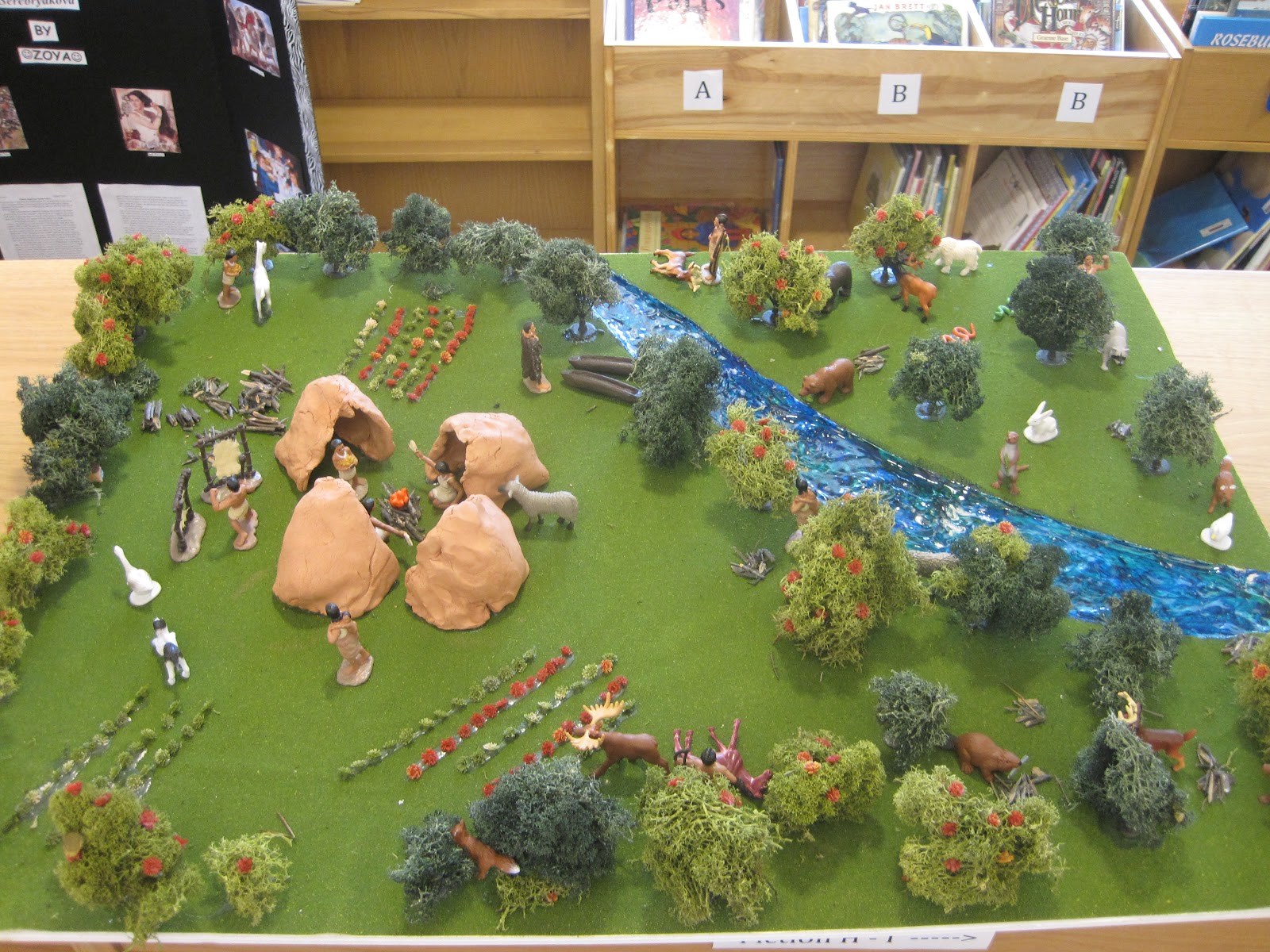 |
| Village by Layla |
 |
| Canoe by Jacob |
 |
| Wetu by Owen |
 |
| Jewelry: Bracelet by Charlie |
 |
| Scene from a folktale by Esmé |
 |
| Mini Garden by Lia |
 |
| Bow and arrow by Jarrett |
 |
| Bow and arrow by Patrick |
Friday, May 18, 2012
Cleaning Out the Library: Literally and Figuratively
I got this charming email from a group of 3rd and 4th graders in Cecelia and Sarah's class:
Dear Natalie,
We are doing a service learning project on a book called The Janitor's Boy. And we want to go to your library and scrape the gum off the tables. If that's okay with you. Your library tables may get covered in gum if we don't. A boy in the book scrapes gum off chairs and tables, so we'd like to try it ourselves. Please type back.
Sincerely,
Elena, Mitchell, and Jasper
 So sure, I typed back. How could I resist? I was SO glad to get the gum scraped from the underside of the tables. The only table in my library with gum under it was a battered old table that came to me from the High School. So now it's no longer in danger of getting covered in gum.
Meanwhile, the wild rumpus has begun. We are now checking out books, up to fifty per family, for the entire summer. I love to watch the joy of the kids and hear the appreciation from the parents, who note that having a stack of carefully selected library books makes summer reading so easy. And it is such a gift to have help from Shannon, our high school intern, and Katie, our indefatigable volunteer, to make this massive undertaking so successful. Checkout statistics:
Normal days:
Thursday, May 10: 77
Friday, May 11: 78
Summer checkout days:
Thursday, May 17: 971
Friday, May 18: 802
And here are the 2012 Summer Reading Lists (right column, PDF).
It's Friday. I'm going home to read a book.
Friday, May 11, 2012
"Where someone loved him best of all..."
 |
| Maurice Sendak, 1928-2012 |

I vividly remember my mother's discovery of Higglety Pigglety Pop: Or, There Must Be More To Life and quoting it to us in veiled but unmistakably hostile grievance. I think it encapsulated her own sense of entrapment and dissatisfaction in that early era of the women's movement far better than anything written by Betty Friedan or Germaine Greer.
I also remember reading Outside Over There, Mickey In the Night Kitchen and Where The Wild Things Are to my sons when they were young. It was truly mind-blowing, disturbing stuff to me. I had just finished an M.A. in English Lit and here were nightmare visions equivalent to Kafka: encompassing coded images of parental sexual activity, the Holocaust, an orgy and death, death, death. And then forgiveness and nurturing and love: Max returns to the world of language and to his lovingly-provided dinner: "And it was still hot."
 I teach Where the Wild Things Are to 11-12 year olds on occasion, explaining Freudian terms, consequences of transgressive behavior, private fantasy, aggression, word vs. image, child vs. mother, and far more. There is a reason it ranks first in every librarians' poll of greatest picture books. Sendak respected kids enough to address both their nightmares and their joys in being alive. As these students exclaim to me, "I loved that book when I was little. We read it all the time. But I had no idea why I loved it -- and now I do!"
As the tributes to Sendak poured in this week, I was moved to tears by one in the New York Times about a 15 year old girl, sitting in the police station, who had been sexually abused. Like so many children in utterly different circumstances, she too found comfort in Where the Wild Things Are. My colleague Anna sent me this letter to Sendak, among his favorites:
“Dear Mr. Sendak,” read one, from an 8-year-old boy. “How much does it cost to get to where the wild things are? If it is not expensive, my sister and I would like to spend the summer there.”
Some recent interviews are below. I would love to hear other memories (comment link, below). I will miss him.
Interview with Stephen Colbert, part 1 (7 min)
Interview with Stephen Colbert, part 2 (7 min)
Interview with Terry Gross audio (hour)
Thursday, May 3, 2012
LIttle Brains at Work
(If you are having trouble seeing the pictures, click to go directly to The Pithy Python)
Two little girls, about age six, were sitting on a bench in the hallway waiting for their teacher to open the door. An elementary mother walks by and into the headmaster's office, a women in her late 30s. One child looks at the other and asks, "Is this old people's day?"
(Thanks to Jennifer "Cupcake" Cook for this one.)
Two other little girls. around age 7, were checking out. Lauren asked one with a broken arm, "When do you get your cast off?" And her friend replied, "Soon! And I will get my full best friend back with NO HARD PARTS!" (Makes you wonder if the friend has been conked a few times by the cast.)
Ken, a teacher of 6 and 7 year olds, came up to the library to tell his class about a change in schedule immediately following their library time. "Today you can head to the playground for fresh air break, or you can go to the lettuce tasting table and have salad." And all the kids exclaimed with some variant of, "Yay! I know what I'm going to do! I'm going to go taste salad!" That should warm many a nutritionist's heart. And certainly Tania's, who has worked so hard with so many classes in the Farm-to-School endeavor.
A mother came by this week to get books for her 8 year old who was recovering from abdominal surgery. She told me that the surgeon came in to chat with her son afterwards, asking the boy where he went to school and what his favorite subject was. He answered, "Well, it's not exactly a subject but..." and he went on to tell the doctor why library is his favorite part of school. He said that, unlike at his old school library where he always felt rushed, he gets time to think, browse, and ask me or friends for advice on what to read. He was a new kid this year and I have so enjoyed watching him use this library in a thoughtful way. And hearing that made me glow all day.
It reminded me of NPR's Story Corps project, National Teachers Initiative, featuring adults who contact and interview favorite teachers from when they were young. The first time someone suggested I do this was the late David Mallory, who ran magnificent teacher development seminars at the Westtown School. I vividly recall the group, after five days of lectures, films, seminars and discussions, meeting for a wrap-up. A roomful of experienced and gifted teachers were reduced to wiping their eyes or even sobbing. When I told our headmaster, Paul Bianchi, about it, he remarked that teachers are some of the most wounded and criticized members of our society, and a week of affirmation must have touched their hearts. So here's one interview that touched my heart: a neurosurgeon successfully restored a patient's ability to speak; the ecstatic patient asked him about his favorite teacher and then said, "You make sure you call that teacher." The teacher's response is so moving: he says that day, that call, ranks up there with the birth of his children as a lifetime highlight. Click here listen to the story and others like it. And then go call or write your favorite teacher. Your words will be treasured.
Two little girls, about age six, were sitting on a bench in the hallway waiting for their teacher to open the door. An elementary mother walks by and into the headmaster's office, a women in her late 30s. One child looks at the other and asks, "Is this old people's day?"
(Thanks to Jennifer "Cupcake" Cook for this one.)
Two other little girls. around age 7, were checking out. Lauren asked one with a broken arm, "When do you get your cast off?" And her friend replied, "Soon! And I will get my full best friend back with NO HARD PARTS!" (Makes you wonder if the friend has been conked a few times by the cast.)
 |
| The Lettuce-Eaters |
A mother came by this week to get books for her 8 year old who was recovering from abdominal surgery. She told me that the surgeon came in to chat with her son afterwards, asking the boy where he went to school and what his favorite subject was. He answered, "Well, it's not exactly a subject but..." and he went on to tell the doctor why library is his favorite part of school. He said that, unlike at his old school library where he always felt rushed, he gets time to think, browse, and ask me or friends for advice on what to read. He was a new kid this year and I have so enjoyed watching him use this library in a thoughtful way. And hearing that made me glow all day.
It reminded me of NPR's Story Corps project, National Teachers Initiative, featuring adults who contact and interview favorite teachers from when they were young. The first time someone suggested I do this was the late David Mallory, who ran magnificent teacher development seminars at the Westtown School. I vividly recall the group, after five days of lectures, films, seminars and discussions, meeting for a wrap-up. A roomful of experienced and gifted teachers were reduced to wiping their eyes or even sobbing. When I told our headmaster, Paul Bianchi, about it, he remarked that teachers are some of the most wounded and criticized members of our society, and a week of affirmation must have touched their hearts. So here's one interview that touched my heart: a neurosurgeon successfully restored a patient's ability to speak; the ecstatic patient asked him about his favorite teacher and then said, "You make sure you call that teacher." The teacher's response is so moving: he says that day, that call, ranks up there with the birth of his children as a lifetime highlight. Click here listen to the story and others like it. And then go call or write your favorite teacher. Your words will be treasured.
Subscribe to:
Posts (Atom)


 Posts
Posts


